Carolina Butterfly Society 2026 Symposium
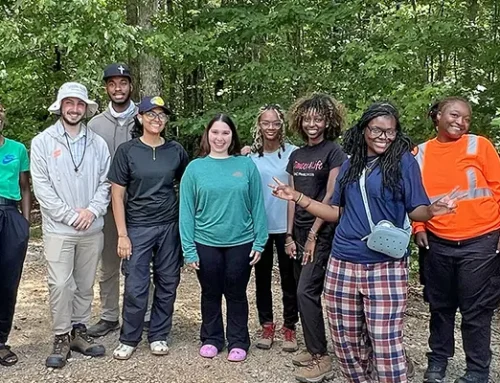
The Carolina Butterfly Society brought a flurry of activity with butterflies, moths, field observations, and shared knowledge to Chesterfield County the weekend of September 11th–13th. With Southern 8ths Preserve serving as the setting for both field exploration and Saturday’s symposium, participants had the opportunity to spend the weekend learning about butterflies and moths both in the classroom and out in the field.
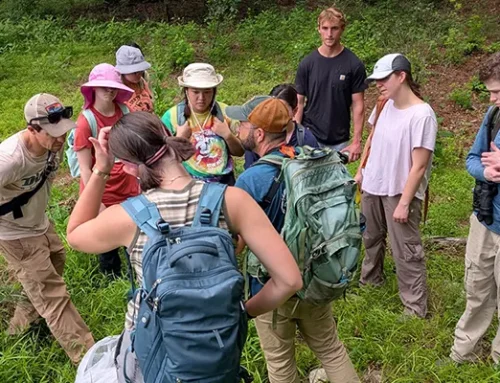
The weekend began Friday afternoon at Southern 8ths Farm, where twelve participants joined Tom Austin to survey two sites across the property. Despite the hot and humid September weather, butterflies were plentiful.
In just under three hours, this talented group documented 386 adult butterflies representing 16 species. Sleepy Oranges led the count with 102 individuals, followed by 92 Fiery Skippers, 65 Cloudless Sulphurs, and 46 Eastern Tailed-Blues. Variegated Fritillaries, Common Buckeyes, Monarchs, hairstreaks, Duskywings, and several other skippers rounded out the afternoon’s observations. A single Sachem was another notable observation and represented a new species for the site based on the group’s previous surveys.
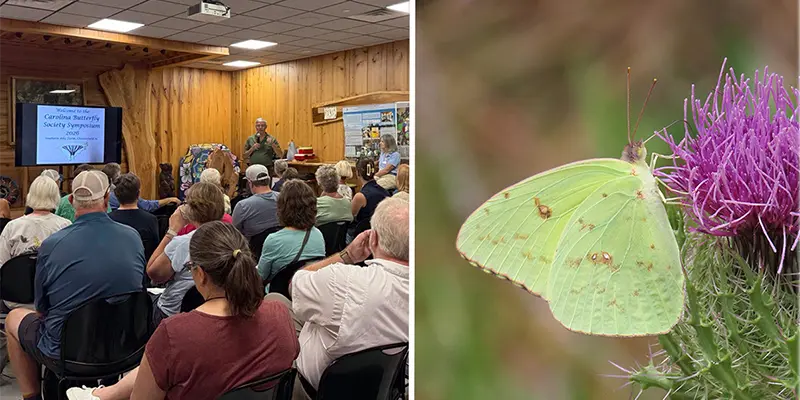
Meeting in the Learning Center, Cloudless Sulphur
But the adults were only part of the story. Participants also found at least four Cloudless Sulphur caterpillars feeding on sickle pod, 14 Sleepy Orange caterpillars, two Variegated Fritillary caterpillars on Purple Passionflower, and two Monarch eggs on a small butterfly weed. These sightings remind us that we can all make a difference by growing the native “host plants” that so many butterflies and other pollinator species rely on for their full life cycle.
After an afternoon spent searching the fields, Saturday was the day for everyone to gather inside the Southern 8ths Learning Center for the Carolina Butterfly Society Symposium.
Dave Kastner, Tom Austin, and Brad Turley welcomed attendees before a series of presentations exploring butterflies and moths from several different perspectives. Jeff Smith began with “On the Hunt: My Journey Searching for Butterflies,” sharing his experiences in pursuit of butterflies.
Dr. Carol Boggs, Professor and Director of the School of the Earth, Ocean, & Environment at the University of South Carolina, followed with “Wing Color, Pattern and Male Attraction,” exploring how butterfly appearance can play a role in attraction. Hannah Walton, a PhD candidate at Auburn University, took a closer look at seasonal variation in the Southern Dogface during “Life is Plastic, It’s Fantastic: A Close Look at the Seasonal Variation of the Southern Dogface.”
The day concluded with Dr. Brian Scholtens, Professor of Biology at the College of Charleston, and his presentation, “Surveying Moths in South Carolina: What We Know and What We Don’t Know.” His talk highlighted not only what researchers have learned about the state’s incredible diversity of moths, but also how much remains to be discovered.
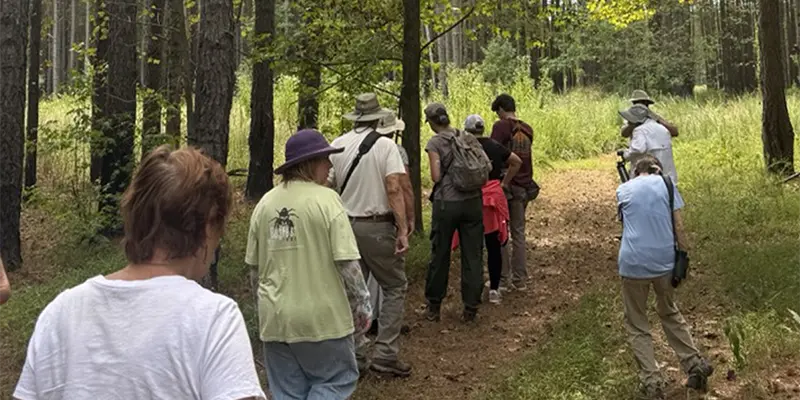
On Sunday, participants headed back into the field, this time at Carolina Sandhills National Wildlife Refuge – with its completely different Longleaf Pine forest ecosystem, right down the road from our Piedmont hardwoods and grasslands. Twelve participants joined walk leaders Dave and Marty Kastner for nearly five hours of surveying under sunny skies.
And there were plenty of butterflies to find.
Sleepy Oranges, Variegated Fritillaries, Common Buckeyes, and Cloudless Sulphurs were present in such large numbers that counting every individual was impossible. Even with conservative counts, the group documented at least 551 adult butterflies representing 29 identified species. Sleepy Oranges were especially abundant with 275+, followed by 64+ Variegated Fritillaries, 51+ Common Buckeyes, 41+ Cloudless Sulphurs, and 40 Palamedes Swallowtails, a species that is more typical of the Coastal Plain.
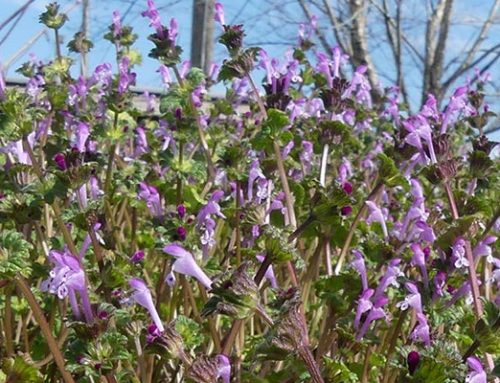
Sunday also brought the weekend’s moth discussion into the field at Southern 8ths. Dr. Scholtens joined the walk, and the group documented eight moth taxa in addition to the butterflies. These included the Orange Epipagis moth, Vetch Looper moth, Genista Broom moth, Soybean Looper moth, Tobacco Budworm moth, and larvae of Io and Fall Webworm moths.
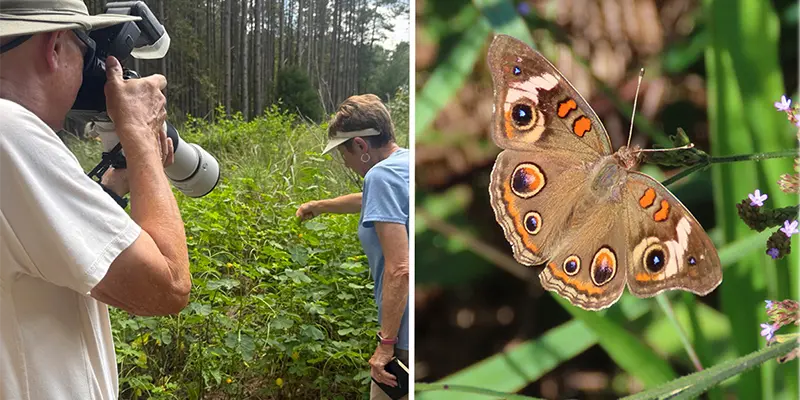
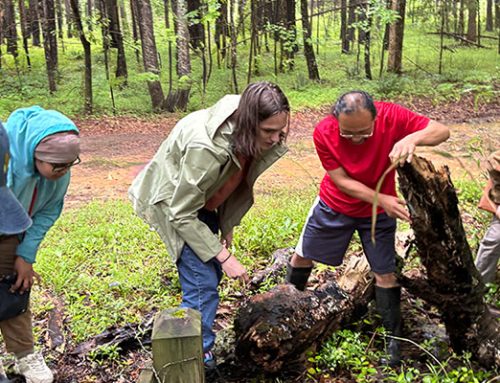
Photographing larva in the field, Common Buckeye
Caterpillars continued to be part of the observations as well, with larvae of Monarchs, Common Buckeyes, Gulf Fritillaries, and Variegated Fritillaries documented during the survey. A Dion Skipper provided another notable find, representing another new species for the site based on the Kastners’ previous observations.
From counting hundreds of butterflies in the field to discussing the questions scientists are still working to answer, the Carolina Butterfly Society Symposium weekend offered a closer look at the diversity found throughout the Carolina Piedmont and Sandhills. It also demonstrated the value of bringing researchers, naturalists, and butterfly enthusiasts together to share observations and knowledge. We are proud to serve as their hosts.
Sometimes learning more about the natural world simply starts with heading outside and seeing what you can find!
You can learn more about the Carolina Butterfly Society on their website, https://www.carolinabutterflysociety.org/.